Search
Showing 10 of 7395 results
- Diana Murdoch copy
-
Latest insights on international education
The Insight Story March 2022 is the latest snapshot of international education from Education New Zealand Manapou ki te Ao.
This fourth issue includes research, insights and trends on:
• our top source markets
• other English-speaking international student destinations
• student visa numbers
• international student experiences
• transitions from secondary to tertiary study in four priority Asian markets.
Do you know, for example, which countries are most interested in our Study with New Zealand website?
Or how students from Japan rate the value for money and cost of living in New Zealand, and their overall experience here?
Or which nationalities have the highest number of student visas granted in other English-speaking international education markets?
Or how positively international students rate their experience in New Zealand, and how international student experience at New Zealand universities compares with the global benchmark?
To find the answers to these questions and more, read The Insight Story and sign up for future issues, on the IntelliLab website.
- AEA BIC 01
- GCC 01
- 1646141903355
- 190913 Chris Cairns
-
ENZ welcomes two new Board members
The Minister of Education, Hon Erica Stanford, appointed two new members to the Board of Education New Zealand Manapou ki te Ao (ENZ) on 7 July 2025.
Sara Brownlie and Prabha Ravi succeed two of ENZ’s long-serving Board members, Dr Linda Sissons and Lyn Provost.
Read on to learn more about the wealth of experience the new Board members bring to the role.
Sara Brownlie

Sara Brownlie is a chartered accountant and chartered director with strong risk and financial management and financial planning knowledge.
She has worked in the public sector for most of her career in senior financial roles including Department of Internal Affairs, Ministry of Justice and at Treasury where she was also Chief Financial Officer for the Department of Prime Minister and Cabinet and for the Public Services Commission. This followed early career at Deloitte and Unilever.
Sara now provides specialist strategic financial and project/programme advisory services through her company Fargher Woods Ltd.
Sara is a board member with Catalyst.net and is the Crown appointed Deputy Chair and Chair of the Finance and Audit Committee of the Research Education Advanced Network New Zealand (REANNZ).
She is also an independent member of Enable New Zealand Finance, Risk and Audit Committee, and holds a similar role with the Upper Hutt City Council's Risk and Assurance Committee.
Prabha Ravi QSM, JP

Prabha Ravi QSM, JP is an experienced governance leader and international education specialist with over 25 years in senior management roles, including International Director at Waiariki Institute of Technology and YMCA Central, and Senior Manager at Education New Zealand. She has represented New Zealand in more than 47 countries, generating millions in export education earnings and building strong global partnerships.
With nearly 20 years of governance experience across the arts, sports, education, health, community, and public sectors, Prabha serves on several boards, including the Wellington/Wairarapa Lotteries Committee.
She is also the founder and director of Natraj School of Dance, a leading Indian classical dance institution in Wellington for over 25 years, and an award-winning actor. Her contributions to education, arts, governance, and ethnic communities have been recognised with multiple honours, including the Queen’s Service Medal in 2017.
You can find out more about the ENZ Board here: Our Board
- NZIEC twitter screenshot2
- Around the world in 24
-
From the CE: Memorable trip highlights value of international education
This was the first mission led by the Prime Minister since our borders closed in 2020, and it combined education, tourism, New Zealand businesses and government agencies. It sent a clear message that New Zealand is open for business and ready to reconnect with the world.
A couple of excellent things happened in Singapore from an education perspective, the first at Gardens by the Bay, which is a nature park of more than 100 hectares, visited by around 14 million people every year.
At a ceremony to mark the unveiling of a bespoke Māori carving, the Chief Executive of Gardens by the Bay, Felix Loh, spoke about his education experience in New Zealand 30 years ago. He said that studying for a Bachelor of Horticulture at Massey University had a huge impact on his life and career, not only because of what he learnt from his studies, but also because of the care and support he received here. It was a great endorsement of the best that an education in New Zealand can offer and highlighted to everyone who heard him that international education brings long-term value.
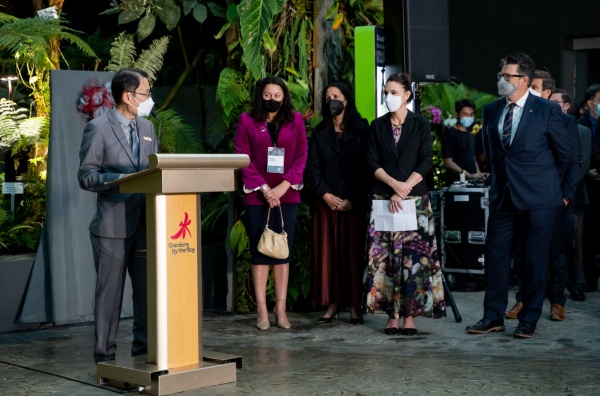
Image: Felix Loh, Chief Executive of Gardens by the Bay, speaks at the ceremony to mark the unveiling of a bespoke Māori carving. Photographer – Karan Gurnani, 35mm.
We had a similar experience the following day, at the signing of an MOU between the Singapore Institute of Technology (SIT) and FoodBowl, a New Zealand food innovation network based in Auckland. The senior signing official for SIT was their President, Professor Chua Kee Chaing, who was a student in New Zealand 40 years ago. Again, we saw the warmth and long-term relationships that are generated by international education.
The Japan part of our trip featured several events with a specific focus on international education, including signing an agreement with Japan Women’s University, relaunching Game on English for female rugby players, and an event at the Cookie Time store in Tokyo with an opportunity to meet previous participants in the working holiday scheme, including former students. You can read more about these events in a separate article in this issue of E-News.
It was great to meet people who feel such a strong connection to New Zealand, even after many years have passed. We often refer to the social, cultural and economic benefits of international education – what we experienced on this trip brought those words to life and marked another significant step on our path to rebuild New Zealand’s international education sector.
He aha te mea nui o tea ao? He tangata, he tangata, he tangata
What is the most important thing in the world? It is people, it is people, it is people.
Grant McPherson