Search
Showing 10 of 7245 results
- Experience of Indian students in New Zealand
- 0126 Studyinnewzealand ThinkNEW 1
- 26799463514 7432811796 b
-
Tauranga-based group visits Korea
E-News caught up with one of the organisers of the visit, Education Tauranga’s Anne Young.
What led to the decision to visit Korea as a group of institutions?
Education Tauranga’s 2013-2017 strategy focuses strongly on collaboration between member institutions. We find that we can make more of an impact in a market as a group, and, with a diverse range of institutions participating in activities, we can demonstrate the pathways that exist within our region to cater for all levels of education.
Korean students are enrolled in the full range of education institutions in Tauranga – from primary right through to tertiary. This is one of the reasons Education Tauranga’s Korean student numbers have continued to rise in 2015, while declining in New Zealand overall. We also attribute our success in Korea to the fact that we have committed local agents, strong local government support, highly effective links with the Korean community in the Western Bay of Plenty and institutions that provide excellent education and care to all international students, including those from Korea.
In choosing Korea as our group visit destination, we were able to further capitalise on our already strong position in that market.
What are the advantages of a group visit such as this?
The main advantage of a group visit is that it’s easier to get noticed and to secure meetings than when you’re an individual institution travelling on your own. Promotional costs can be shared, too. In our case, 21 institutions were pitching in, meaning our advertising dollar went a lot further, resulting greater numbers of prospective students at our fairs and good attendance of officials at other events.
Having trip organisers taking care of all the planning, organising and bookings meant it was a much more efficient process for everybody. It also alleviated stress for some first time travellers to Korea who didn’t have to face many of the challenging ‘unknown factors’ that can pop up when organising your own recruitment trip.
What are the downsides?
I don’t think there are any particular disadvantages to marketing as a group offshore. However, there are challenges in the logistics of dealing with such a large group, such as transport arrangements and getting everyone to where they need to be on time, as well as ensuring that planned activities are of benefit to all institutions from a range of sectors.
What were the highlights?
We attracted over 400 prospective students through our fairs which was a great success for one small region of New Zealand. The students who came along were already pretty well informed about Education Tauranga’s education offerings, demonstrating that the effort that we put into advertising prior to the events hit the mark!
Several alumni families also attended the events, and it was wonderful to see them engaging with prospective students and their families and giving their perspective on what studying in our region is like.
The support of big New Zealand brands such as Zespri was also fantastic; their product promotion at our fair went down really well.
Being hosted at the New Zealand Residence by the Deputy Head of Mission to Korea and Education New Zealand was also a highlight as we were able to recognise the contribution they had made to ensuring our activities were a success.
Are there any outcomes on the horizon or promising connections made?
We’re hoping our visit will result in an increase in student numbers from Korea in 2016. The signs are promising so far, with many new students expressing an interest in coming here. Time will tell however!
We have also strengthened relationships with Tauranga’s ‘friendship city’ of Ansan, with a larger study tour group coming in 2016 than came in 2015.
What would you do differently next time?
The visit to Korea was our second regional group visit (we visited China together as a group in March this year) so we already had experience in what did and didn’t work and were able to iron out any issues prior to this trip.
Any hints and tips for together groups thinking of undertaking this sort of group visit?
I think undertaking a visit of this kind is very effective for regions or groups of institutions. My top tips for making your visit a success are as follows:
-
Do your research and have a plan. Know exactly what activities you want to do and why
-
Involve all participating institutions in the planning process
-
Make sure you have support from local councils and your Economic Development Agency
-
Enter the market with a strong brand that all participants believe in
-
Make sure you have translated materials and have translators who know your product/region
-
The work you do prior to arrival is just as important (if not more than) as the work you will do while in country
-
Work with ENZ and local Embassy staff
-
Leverage your alumni
-
Follow up with the people you met with during the visit!
-
- PMSLA recipients October 2017
- Ronja Group Rain walk.JPG website resize
-
International student employment: overcoming barriers
The panel, chaired by ENZ’s Director Student Experience, Hayley Shields, featured a diverse and informed range of views from
- Brett Berquist, Director International at the University of Auckland
- Dr Cate Gribble, Senior Research Analyst at the University of Auckland
- James Koo, former international student and founder and CEO of Niesh, a free student discounts app
- Paul Hickey, Managing Director at SpeakData
- Charan Mohan, former international student and now Business Intelligence Analyst at SpeakData.
Dr Cate Gribble talked about the need to raise awareness of the benefits to businesses of employing international students to counter employer concerns around the challenges of international student employees, including perceptions they won’t fit culturally, their English will be limited or that their visa situation will make paperwork too challenging. Students also find their international work experience in their home country is not always valued here, and employers often require New Zealand citizens or Permanent Residents.
Brett Berquist added that we need to counter the perception that international students will not stick around.
“The reality is that all students, both domestic and international, are equally mobile. Employers need to stop thinking Kiwis make employees for life, and that international students are a flight risk.”
James Koo said the lack of transparency around these concerns is a challenge for international students. As a result, many international students end up sending a generic CV and cover letter to any and all available jobs, too discouraged to spend time tailoring their CVs to each role.
James also noted that student expectations can sometimes be unrealistic, and some students expect to work in large, prestigious companies whereas most New Zealand companies are SMEs – which he noted can actually offer more opportunities and experiences for students and recent graduates.
SpeakData’s Paul Hickey then talked about his experience hiring international students, such as fellow panellist Charan Mohan. While Charan clearly had the hard skills required for his company, Paul needed to be convinced of his soft skills, which he calls being ‘Kiwi-ready.’
 “Often, international students come into interviews and talk solely about their studies and qualifications when actually, we’re just as interested in hearing about their interests outside of work.
“That social aspect plays a big part – sharing a story about kayaking in Taupo at the weekend or going to an All Blacks game is an easy way to connect with Kiwi employers.”
Paul also talked about the need to work with institutions to create a pipeline of talent.
“Employers often take a short-term view and hire people ‘just in time’ rather than looking ahead, whereas if you expect to have 10 new positions available in two years’ time, why not try to establish a pipeline for talent through local institutions who can connect you with new graduates with relevant skills?”
Panellists also agreed that having internships and work experience in education programmes will also help international students get into the job market when they graduate.
Brett concluded that while all these approaches can reduce barriers, ultimately, a strategy is required – supported by data that is already available in reports such as the Ministry of Education’s ‘Moving Places’, ENZ’s Beyond the Economic and Immigration New Zealand data.
It is an ongoing discussion that will continue to be in the spotlight in New Zealand as the industry works to meet international student expectations of global employability.
-
New Zealand teaching showcased in Thailand
The teachers came from 60 provinces across Thailand to attend the four-day event, along with Chortip Pramoolpol, ENZ Marketing and Strategic Relations Manager – Thailand, and Karen Rutherford, Head of School of AUT International House.
The event provided teachers with new guidelines and teaching techniques to ensure their students get the most from their classes.
AUT conducted a training session showcasing the New Zealand teaching style, which Chortip said received overwhelmingly positive feedback.

Karen Rutherford speaks with Thai teachers.
“Teachers commented on how practical and hands-on it was."
"It helped tighten the education collaboration between New Zealand and Thailand and provided a great platform to raise awareness of us to the teachers and participating government agencies.”
AUT will also select and sponsor one teacher to receive one month of complimentary English language training.
The event was organised by Brand Suntory (Thailand) Co., Ltd in partnership with the Office of Basic Education Commission, Ministry of Education and Kasetsart University.
The Brand’s Tutor Summer Camp ran from 29 June to 1 August 2017.
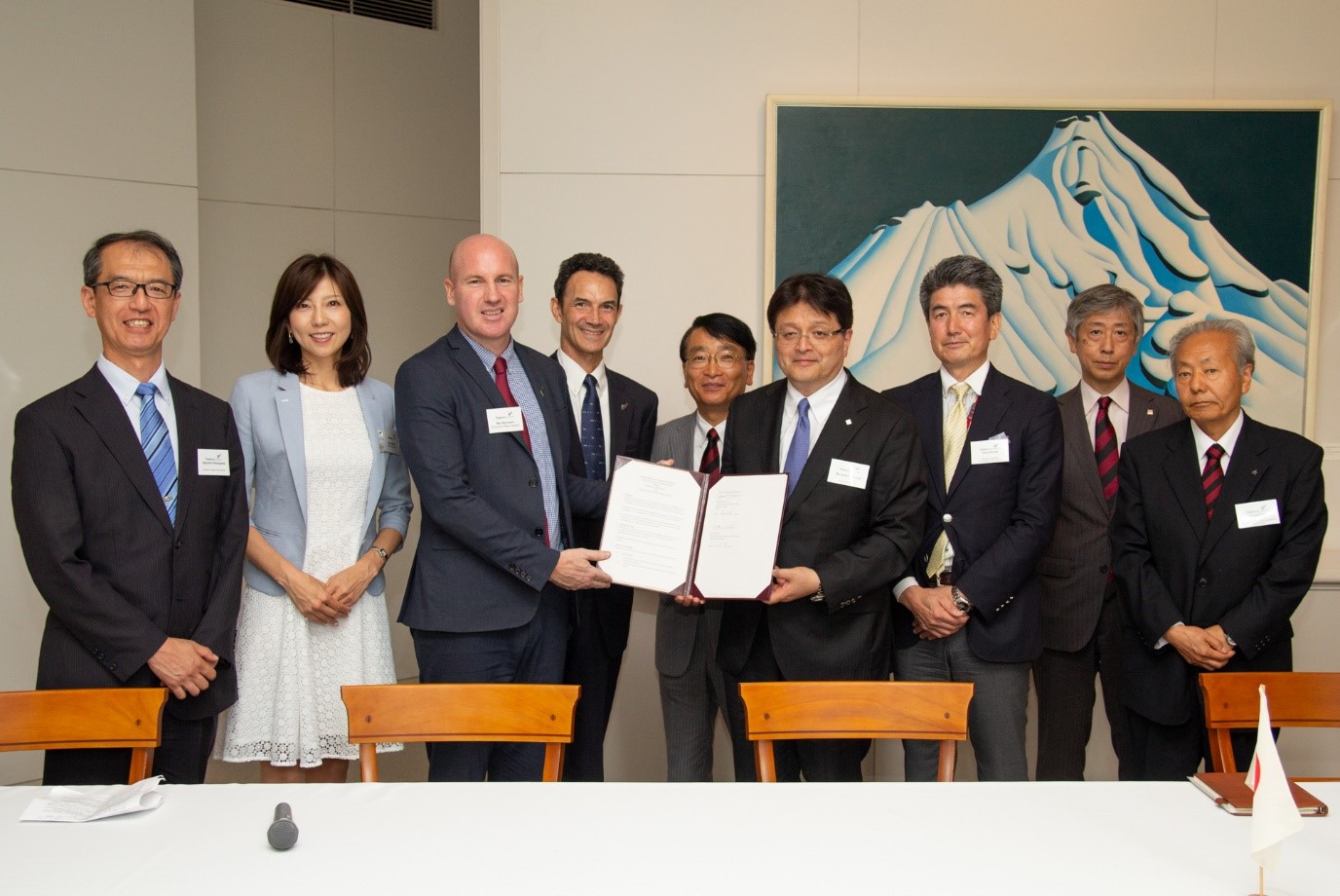
- Japan New Zealand education ties strengthen with growing collaboration
-
Koreans land safely into New Zealand schools
They are in New Zealand for an eight-week programme that includes English language provision. The programme is a direct result of the Free Trade Agreement signed in December 2015 between New Zealand and South Korea.
Peter Bull, ENZ General Manager International, said the Korean students are the children of farming or fishing families, and are all high performing students.
“The opportunity to study in New Zealand and to represent their family, school and Korea in this inaugural year of the scholarship scheme saw students go through a selection criteria that whittled down over 2,000 applications to the 150 selected.”
ENZ partnered closely with the Schools International Education Business Association (SIEBA) to implement the scholarship scheme in New Zealand through its member schools, and to help manage the logistics involved in coordinating such a large group of students at once.
Peter paid tribute to SIEBA for also delivering orientations in the three regions to ensure that the transition into New Zealand life was as seamless as possible for the Korean visitors.
A highlight of the orientation programme occurred at Canterbury’s Pudding Hill Lodge, near Methven. The students were welcomed with a waiata from some talented Mount Hutt College students. This was followed by a very warm welcome from Tertiary Education, Skills and Employment Minister Steven Joyce that was then reciprocated by the Korean students.
The other welcome ceremonies were held at St Paul’s Collegiate School in Hamilton, which was attended by the Korean Ambassador, and President of EPIS, the Korean agency responsible for the implementation of the programme, and at Garin College in Nelson.
As agreed under the KNZFTA, 450 students will be granted scholarships to study in New Zealand over three years.
The arrival of the students has made the headlines in the local press. Here are just some of the stories which have been published so far.