Search

Showing 10 of 7355 results

  • Exploring a vision for the ‘Future of International Education’ in Aotearoa

    It was an action-packed week in Wellington for Emeritus Professor Bean and his business partner Helen Souness. They were invited to Wellington by Education New Zealand Manapou ki te Ao (ENZ) to facilitate discussions on what the future may look like for Aotearoa New Zealand’s international education sector

    Professor Bean is former Vice Chancellor of The Open University in the United Kingdom and RMIT University in Australia, and is now CEO of the Bean Centre. Along with his business partner Helen Souness, former CEO of RMIT Online, they partner with education experts, education providers and technology companies to shape an education future that works for the rapidly evolving needs of learners, and the evolving landscape of work they will eventually be part of.  

    On Tuesday 1 August, ENZ hosted a cross-section of representatives from our international education partners in government, industry and tertiary education institutions at a full-day workshop. The aim of the workshop was to bring together our sector and collectively explore a vision for the future of international education in Aotearoa New Zealand. This work is a key part of Focus Area 2 of the New Zealand International Education Strategy 2022-2030 (NZIES) and how we can diversify our educational products and services and modes of delivery to create a more sustainable and resilient future. 

    ENZ’s Chief Executive Grant McPherson opened the event and said that it was a privilege to host experts in the field of international education and have them share their knowledge and experience on what is disrupting the world of tertiary and international education globally and what other countries are doing in the face of these challenges. 

    ''I would like to thank everyone that came along with such energy and great ideas. It was a fantastic day and the collaboration between government, industry, and the education sector served to generate some inspiring ideas on how, as a country, we can innovate and differentiate our international education sector to remain competitive on the world stage.  

    ''This is especially important work given the challenges that the international education sector is facing not just in Aotearoa but also around the globe. Professor Bean and Helen Souness really inspired us to think about the future of our sector from the point of view those around us including learners, communities, and industry, in the face of these challenges’’, said Grant. 

    Professor Martin Bean and Helen Souness had this to say about the 1 August workshop.

    YouTube YouTube

    Professor Bean also saidI was delighted to participate in a week of deep thinking as we collectively imagined a brighter future for New Zealand’s international education sector. 

    “It’s clear that the world of work and tertiary education is changing rapidly and it’s great to see that colleagues in New Zealand are determined to meet the challenges and build a strategy to thrive in turbulent times”. 

    Another highlight of the day included a presentation from social innovators Hinepounamu Apanui-Barr and Briana Te Haara-Barr on the work that Tokona te Raki: Māori Futures Collective is doing in finding indigenous solutions to global challenges. Their case study and discussion provided valuable input to the day as we then discussed Aotearoa’s unique value proposition. 

    ENZ’s Sector Engagement General Manager Wendy Kerr, whose team is leading the work involved with Focus Area 2 of the NZIES, said that in the days following the workshop, the ENZ innovation team met with our international education agency partners to reflect on the discussions and wonderful ideas that were brought to the table during the day’s workshop. 

    “It’s not often we get a chance to shape the future and this week has proved a valuable foundation for many in our sector to contribute to the course of the future of international education for Aotearoa. And what an exciting privilege that is. 

    She added, ''Now the hard work really begins, and ENZ will be leading the development of a green paper that will be the basis for consultation with our international education partners including government, education providers, industry, iwi, the wider community, and of course, our learners. Watch this space for the exciting developments to come!’’ 


  • Korea ATEED edit

  • Employers embrace influence of international students

    These employers know that, along with their skills, the international graduates bring rich cultural context, a fresh perspective, an innovative mindset, and a solid work ethic to the office each day.  

    Assurity Consulting, a New Zealand-owned digital delivery services consultancy, has been hiring international students for their graduate programme almost since the company’s inception 17 years ago. Last year it won the International Student Workplace category at the Wellington International Student Excellence Awards

    “From very early on we took an approach of inclusive selection,” says Aron Chantelau, General Manager, People and Capability. “We wanted to find people whose values aligned with ours instead of simply trying to select based on people’s background and whether or not they went to Uni.”  

    Assurity has also partnered with Wellington NZ’s Employer Connect programme, established to provide insights into the business environment and networking opportunities for graduating international students; and the Work Ready programme, offering support on CV writing, cover letters, and what to expect from the hiring process.  

    “For the students, it is an opportunity to build their own network in a place where that might not otherwise be easy. For our staff, they get to connect with new people outside the industry and learn about the challenges the international students face, which gives them greater perspective.” 

    Aron says the students who attend both programmes are engaged, good at taking feedback, and highly motivated to start their careers.   

    Learning from each other 

    For Assurity, employing international graduates is about much more than filling jobs in the tech sector. “Our international graduates bring diversity of thought to our teams, which benefits our clients,” Aron says. “They also bring innovation, introducing new ideas and fresh perspectives which has led us over the years to try new things. And, culturally, it makes for an enjoyable workplace because there’s lots to learn from each other.” 

    He acknowledges there can be challenges, especially for students with English as a second or third language but says it’s all about providing the right structure and level of support. “We have a People Lead in all our teams. That role can be about supporting career progression, but it can also involve pastoral care - understanding what challenges that person is facing and helping to mitigate them.”   

    In Southland, Blue River Dairy is another company which recognises the value which international student graduates bring to their business. Since 2018, Blue River has hired more than 30 international students from the Southland Institute of Technology (SIT) and other institutions.  

    “The culture within an organisation is so important. Hiring only for skills is short-sighted,” says People and Capability Manager Abbigail Surridge. “With many of the international students that we have hired, we’ve been able to harness their life experience, dynamic exposure, and untapped potential as they have grown in their roles.”

    “Diversity adds value to our organisation, by introducing different ways of thinking and problem-solving. When we collaborate, those differences help to create success.” 

    Jacky Shen arrived at SIT from Beijing in 2017 to study for his graduate diploma in Information Technology (IT). He already had a Master’s degree in Communication and Information Systems but wanted to better understand the New Zealand tech environment. He is now a software engineer at Blue River, leading a team of three. 

    Not only does the company benefit from Jacky’s technical skills, but also his language skills. “We have a number of Chinese suppliers, so I can speak to them easily and provide quick solutions for them,” he says. “Many companies want applicants to have local experience, but Blue Dairy allowed me to gain that experience on the job. It’s been a great opportunity.”  

    Economic and cultural influence 

    He believes that international students bring real value to the workplace. “We come with good technical skills, but we also contribute to the economy and to the cultural diversity of the country. It’s a win-win.” 

    Aron Chantelau says the international students who work in New Zealand have a bright future, whether here or overseas.  

    “They make a huge difference to our economy, both in terms of digital outcomes for New Zealand but also improving the quality of life here through the work they do,” he says. “Some of them will move overseas but if they’ve had a good experience here, they will become ambassadors for New Zealand.  

    “It’s great to be part of their journeys.”  

  • Around the world in five

    Around the World in Five 


    NEW ZEALAND

    How New Zealand inspires and cares for international students

    The government has recently announced that 1,000 students will be allowed to return to New Zealand in stages from April 2021 onwards. This initiative is just the tip of the iceberg in a series of efforts set to eventually unfold –– all part of a rigorous recovery plan for its international education sector. “It underscores the government’s commitment to the international education sector, which is important in the country’s long-term economic recovery from COVID-19,” says education minister Chris Hipkins.

    Read more


    UNITED STATES

    Looking ahead into the unknown: US study abroad sector predicts cautious recovery

    Pent up demand to travel and a resilient sector is giving US outbound program specialists hope – following the collapse of business as a result of the global health pandemic. But some warn that recovery will be gradual and the market will not return to its usual vitality until after 2024.

    Read more


    AUSTRALIA

    ‘Very concerning’: Indian students abandon Australian universities

    The number of new Indian students choosing to study at Australian universities collapsed by more than 80 per cent in the second half of 2020, in a further blow to the country’s more than $30 billion international education system.

    Read more


    GLOBAL

    New edtech startups aim to reinvent the online classroom

    The chaos of 2020 forced educators to quickly adopt video conferencing tools such as Zoom and Google Meet to teach their students remotely. While none of those services had been specifically built for education, it hasn’t taken long for a new generation of edtech providers to enter the marketplace.

    Read more


    GLOBAL

    Why universities will need to digitalise to survive

    Universities, and the role they play in society, are under threat from the impact of the ongoing pandemic.

    Read more

  • E-News content refresh coming soon

    The E-News content refresh is the outcome of ENZ’s review of analytics over the past year. This has demonstrated our readers’ strong preference for forward-looking market insights and intelligence updates.  

    By tailoring the newsletter content to audience preferences, ENZ will be able to deliver a sharper, more insightful E-News to the international education sector.

    ENZ’s General Manager – Stakeholders and Communications, John Goulter, said that ENZ is keen to offer more value through E-News, which is ENZ’s main industry-focused channel.   

    “We want to ensure we’re using E-News to truly help international education thinking and deliver better value to industry,” John said.

    “With the new format, we will aim to share more market insights and updates from our International team and other sources, and articles on trends, new initiatives, research findings and other intelligence to help industry make informed decisions on marketing, student experience and adapting to the rapid pace of change in international education globally.”

    The changes mean that from August onwards, we will publish E-News monthly instead of fortnightly.

    The final fortnightly E-News issue will be published on 31 July, followed by a monthly issue starting the week of 19 August.  

  • From the Acting Chief Executive: A lot to be proud of

    Tēnā koutou katoa 

    Earlier this month a New Zealand business publication ran a column that challenged the role of international education in delivering our Government’s objective of double the export earnings. As you might expect, I could not let the challenge go unanswered. You can read the full response on the ENZ website, but I thought there was merit in highlighting a couple of the key points along with some of the excerpts as they provide a good summary of the state of international education in New Zealand today.  

    The first point I made in my response confirmed that students are returning. We recently published the Ministry of Education’s enrolment data for 2023 (part-year) which firmly backed this up.  

    “Students are returning to New Zealand. In the first eight months of 2023 international student enrolments topped 59,000 with all sectors experiencing growth except wānanga. Accepting that it is from a low base, comparing 2023 to 2022, Universities have bounced back strongly reporting a 15% increase from 24,040 to 27,535.“  

    “In the first eight months of 2023 English Language Schools saw the greatest percentage increase in international enrolments, increasing by 347% from 1,565 to 7,001. Schools reported a 114% increase from 5,925 to 12,662. NZIST Te Pūkenga, a 32% increase from 4,955 to 6,560 and Private Training Establishments (funded and unfunded), a 13% increase from 5,000 to 5,671.”   

    Of these enrolments, students from India continue to provide the second highest number of enrolments in New Zealand. In recognition of our valued partnership, I am delighted to announce that the Republic of India will headline as Country of Honour at NZIEC KI TUA 2024.  

    The designation of Country of Honour at NZIEC KI TUA celebrates our international education connections with partner countries and I am pleased that we can celebrate the growing education connections between our two countries in this way. You can read more about this announcement along with a call for speakers in our E-News story here.  

    The second point from my response that I would like to reiterate is that: We have a plan and the sector is working together to deliver. 

    I highlighted that “The New Zealand International Education Strategy, revised in 2022, sets out a multi-year action plan to develop a high-value, resilient and innovative education sector for both international and domestic students. Further the new Government’s manifesto made clear their vision and priorities for international education. “ 

    “I can also assure you that the sector is working together to achieve its goals, that all eight universities participated in a recent ENZ-led delegation to India, is just one example of the co-operation.”  

    It was very timely that I then received a wonderful note of appreciation from a Dunedin City Councillor this week for the work of the many people within ENZ and the sector involved with the recent Korean agent famil. This was further evidence that we are working collaboratively as a sector and delivering benefits to the international education ecosystem and our regions.  

    Councillor Christine Garey said “The input from ENZ has helped over the years to establish and maintain an international education ecosystem in the city. It’s encouraged transitions between school and tertiary education and supported a strong growth agenda with increased higher quality students staying longer.  

    However, of particular benefit has been access to inbound/outbound famils and delegations. ENZ’s support in bringing agents to our city has been especially valuable and allowed us to showcase what Ōtepoti, Dunedin has to offer. There is no replacement for this in person experience and we look forward to these visits continuing to rebuild relationships globally. 

    Study Dunedin and the international education ecosystem are in good heart here in Ōtepoti Dunedin, working collaboratively and effectively. We look forward to ENZ’s continuing support and especially, we warmly look forward to welcoming future famils to our city.” 

    Keep up the great work, everyone. 

    He manawa tītī  

    Endurance is a virtue that cannot be understated. 

    Dr Linda Sissons 

    Acting Chief Executive 

  • BrandLab screenshot

  • NZ Intensive Spanish PMSLA Programs final

  • Education ties with China

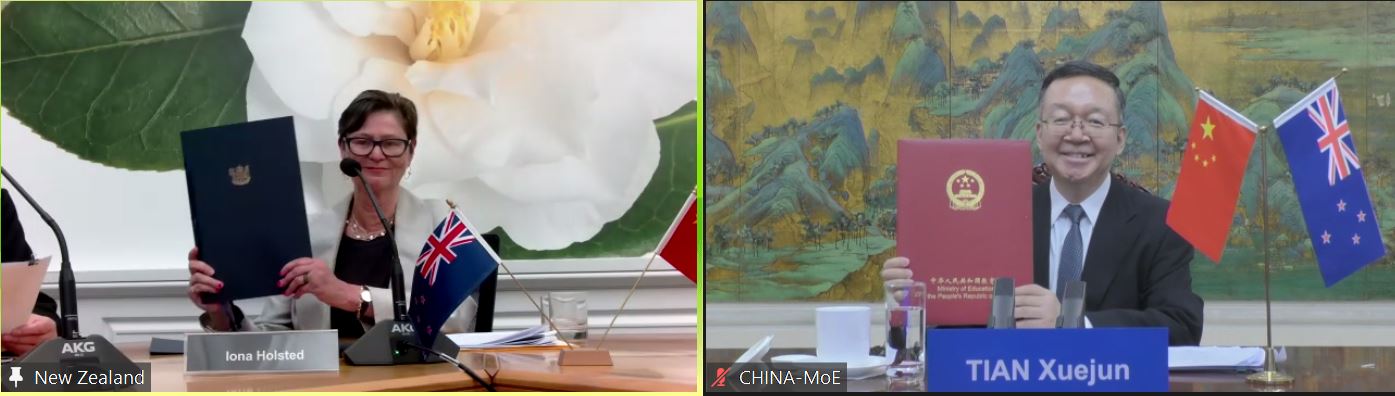
    People’s Republic of China Education Minister Huai Jinpeng and New Zealand’s Education Minister Chris Hipkins met virtually on 23 August 2022. This was their first meeting since Minister Huai took up his appointment in August last year.   

    During the meeting, ministers and officials signed the renewal of the Education Cooperation Arrangement between the two Ministries of Education. Co-operation in higher education, vocational education as well as early childhood education were among the topics discussed. Both ministers expressed the importance they place upon our mutually beneficial education relationship and our people-to-people ties.  

    Left to right: Lisa Futschek, GM International at ENZ, Grant McPherson, Chief Executive at ENZ, Education Minister Chris Hipkins, Andy Jackson, Deputy Secretary Policy at Ministry of Education, Shelley Robertson, GM International Education Policy at Ministry of Education, attending the meeting in Wellington.

    This year New Zealand and China are celebrating 50 years of diplomatic relations, and people – Tangata – is one of the key themes for the celebrations. 

    ENZ’s Director for Greater China, Miranda Herbert, say that the Covid-19 restrictions currently in place in China continue to affect people’s ability to move around or meet in person. 

    “We are constantly looking for ways to continue engaging with key people in China,” she said.  

    “Holding this meeting virtually was a way for us to maintain and build our government-to-government relationships, even though there has been a pause in mobility. 

    “The discussion between ministers highlighted the strong foundation of the education relationship  and the continued collaboration across initiatives such as the Tripartite Partnership Programme, the Early Childhood Education Symposium and forums on vocational education and training.  

    Looking ahead there will be further events and initiatives to continue to build people-to-people links in the education sector.  

  • Startegy edit

What's in it for me?